


Have you ever been told you're an Aries, only to enter the same birth details into a Vedic astrology calculator and receive Pisces? The usual answer focuses on a roughly 24-degree gap, but that leaves out the question Australian readers need answered: how often does a real chart change signs, and what should you do with the difference?
The short answer is that tropical and sidereal astrology calculate the same birth moment from different reference points. Tropical astrology anchors the zodiac to the seasonal equinoxes and remains the framework behind most Western horoscope columns. Sidereal astrology applies an astronomical correction, called an ayanamsa, to align chart positions more closely with fixed-star reference points. The two systems can therefore produce different Sun, Moon, rising-sign and planetary placements without either calculator making a mathematical mistake.
That distinction matters locally. Australian audiences commonly encounter tropical astrology through mainstream media, while sidereal astrology is more often associated with Jyotish and South Asian consultations. An Australia-linked Samsung survey reported that 31% of Australians had made a shopping decision based on astrological timing, while 53% said astrology had guided them at some point during the year (reported survey details). Astrology is therefore not only a question of identity. For some people, it becomes part of planning, relationships, lifestyle choices and timing.
| Question | Tropical astrology | Sidereal astrology |
|---|---|---|
| Main reference | Seasonal equinox framework | Fixed-star reference framework |
| Common Australian context | Western horoscope columns and popular apps | Jyotish, Vedic consultations and predictive work |
| Typical result | Keeps familiar Western sign dates | Usually places planets earlier in the zodiac |
| Main practical issue | Personality and symbolic seasonal interpretation | Chart calculation, nakshatras and timing techniques |
This article is a working map rather than a verdict. It will answer which system is older, whether either is “more accurate”, why placements flip near boundaries, which framework may suit love or career timing, and how to check a chart properly in Australia.
Table of Contents
- Why the Same Birth Date Can Mean Two Star Signs
- The Origins of Tropical and Sidereal Zodiacs
- Precession, Ayanamsa and the 24-Degree Gap
- How a Natal Chart Shifts Between the Two Systems
- How Vedic Astrology Can Help
- Choosing a System for Horoscopes and Compatibility
- Checking and Converting Your Chart in Australia
- Common Misconceptions Worth Putting Aside
- Practical Recommendations and FAQs for Aussie Readers
Why the Same Birth Date Can Mean Two Star Signs
The confusion usually begins with a familiar scene. You read a horoscope in a Sydney newspaper or on an app, and your birthday places you in Aries. Later, a Vedic practitioner asks for your birth time and location, calculates a sidereal chart, and calls your Sun Pisces. It can feel as though one of the readings has changed the facts.
The birth moment hasn't changed. The coordinate system has.
Two zodiacs, one sky
Tropical astrology treats the March equinox as the start of Aries. Its zodiac is divided into twelve equal signs, each associated with a section of the seasonal cycle. Under the familiar Western dates, tropical Aries runs approximately from 21 March to 19 April (historical comparison of the two systems).
Sidereal astrology uses a stellar reference and corrects for the gradual movement caused by precession. Under Lahiri ayanamsa, one commonly used sidereal standard, Aries falls approximately from 14 April to 14 May (sidereal and tropical sign-date comparison). A person born in late March or early April may therefore be tropical Aries but sidereal Pisces.
That doesn't mean every placement moves to a different sign. A planet close to the middle of a sign may remain in the same sign under both systems, although its degree changes. A planet near a boundary is much more likely to shift. The Sun gets most of the attention because popular horoscopes focus on it, but the Moon, Mercury, Venus, Mars and Ascendant can also move.
Why the difference feels bigger online
Australian readers often move between systems without realising it. A general horoscope may use tropical Sun signs, a dating profile may ask for a Western sign, and a Vedic consultation may interpret the sidereal Moon, lagna and nakshatras. Each source can be internally consistent while using different assumptions.
Practical rule: Before comparing two readings, check whether both charts use the same zodiac, ayanamsa, house system, birth time and location.
The useful questions aren't “Which app is wrong?” or “What's my one true sign?” They're which system is older, what kind of accuracy is being claimed, which framework suits love or career timing, and how can you check or convert your chart in Australia without mixing interpretations?
The Origins of Tropical and Sidereal Zodiacs
Why can the same Australian birth date produce different star signs? The answer begins with two traditions that developed from the same skywatching practice but organised planetary positions around different reference points.
The seasonal line
In the Hellenistic world, astronomers and astrologers developed a zodiac anchored to the equinoxes. The tropical framework starts Aries at the March equinox and follows the seasonal cycle. Western astrology later carried that seasonal wheel through medieval, Renaissance and modern practice.
Tropical astrology therefore works as a seasonal coordinate system. Its Aries point does not claim that the Sun must sit inside the modern astronomical constellation Aries. It marks the relationship between the Sun, Earth and the yearly cycle, much as a calendar marks a season without being a photograph of the natural world.
The stellar line
Sidereal astrology follows a different reference. It maintains a relationship with fixed-star positions and applies a correction for the changing orientation of Earth's axis. Indian Jyotish developed its own methods within this approach, including attention to the Moon, nakshatras and planetary periods.
Modern sidereal astrology is not one uniform practice. Cyril Fagan helped establish a Western sidereal movement in the late 1940s, giving sidereal work a more formal modern presence. The International Astronomical Union standardised 88 official constellations in 1930. That distinction matters because astronomical constellations and astrological signs are different categories (historical discussion of tropical and sidereal traditions).
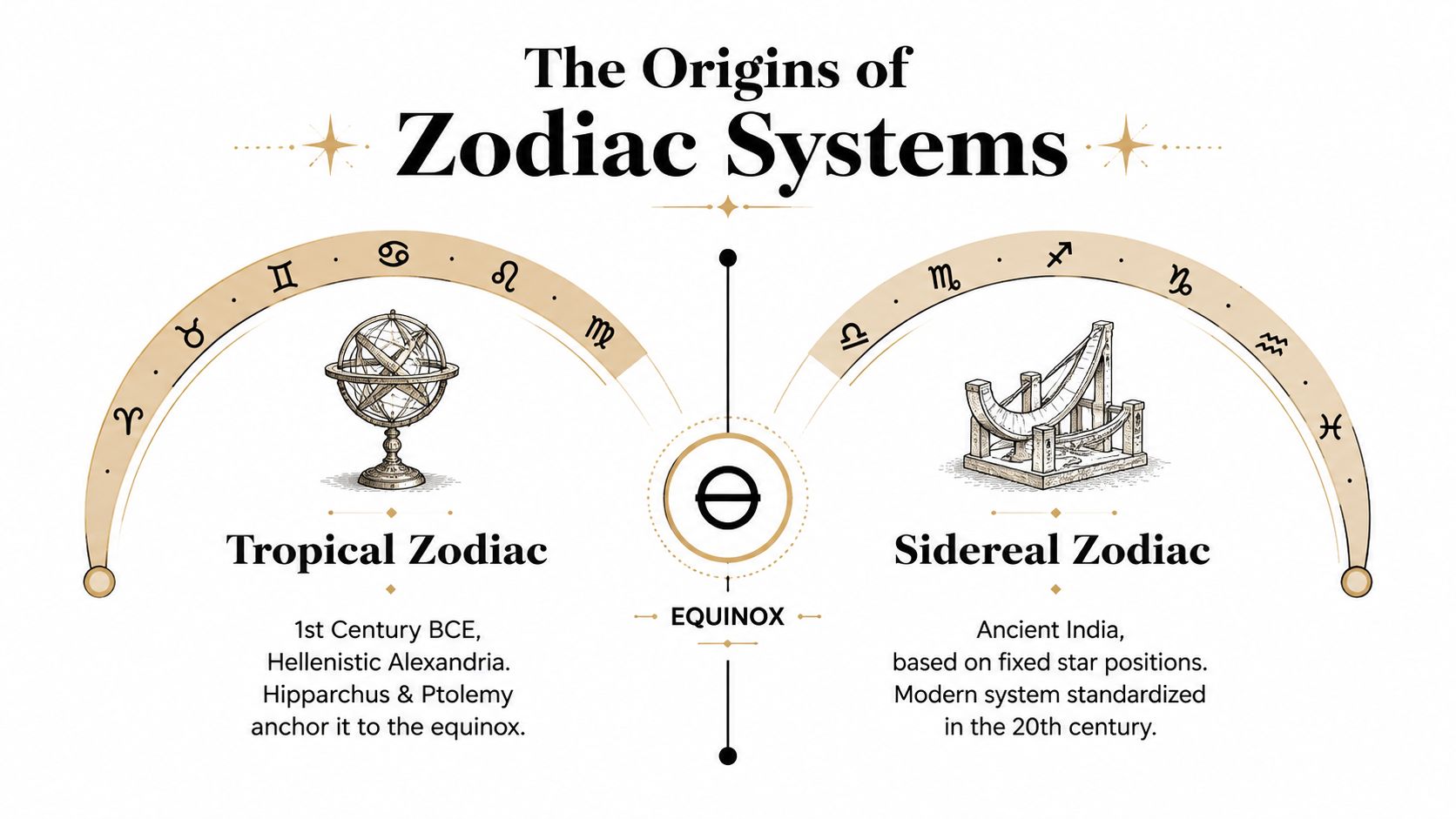
An Australian client's chart can therefore be read in two historical languages. A Western astrologer might interpret tropical Aries as a seasonal symbol. A Jyotish practitioner might interpret a sidereal Pisces Sun alongside the Moon, lagna, nakshatras and dasha periods. The calculations differ, but the practitioners do not need to deny that the other system exists.
A parallel tradition today
The practical difference is cultural as well as technical. Tropical astrology dominates the casual Western horoscope environment many Australians encounter through media and apps. Sidereal astrology is more likely to appear in Vedic consultations, including services used by Indian-Australian and Sri Lankan-Australian families.
The purpose of a reading often explains the choice. Tropical astrology is commonly used for personality-focused interpretation and familiar sign-based material. Sidereal Jyotish usually gives greater weight to the complete chart and timing methods. A reader can consult both, provided each interpretation stays connected to its own zodiac and method.
That approach also clarifies why a real Australian chart does not always flip every placement. Some planets remain in the same sign, while placements near a boundary change. The Sun may switch signs and attract attention in a horoscope, but the Moon, personal planets and Ascendant can shift as well.
Precession, Ayanamsa and the 24-Degree Gap
Why can the same birth date produce different star signs? The answer begins with precession, the slow change in the direction of Earth's rotational axis. As that axis shifts, the equinox point moves westward against the stellar background. The movement is gradual, yet astrology has used the zodiac for long enough for the separation to become significant.
The equinox point shifts westward by about one degree every 72 years, creating a gap of roughly 24 degrees over about two millennia (precession and the zodiacal offset). An Australian explanation places tropical signs more than 23 degrees away from the fixed-star positions used in sidereal and Vedic calculations (Australian explanation of tropical and sidereal charts).
What ayanamsa does
An ayanamsa is the angular correction a sidereal system applies to account for the separation between the equinox-based zodiac and its chosen stellar reference. It is not a planet or an extra sign. It sets the sidereal zero point, particularly the position of 0° Aries.
Lahiri ayanamsa is widely used in Jyotish and is the practical standard many Australian readers encounter when they choose “sidereal” in a chart calculator. Other practitioners use Krishnamurti, Raman or Fagan-Bradley corrections. The choice can move a planet enough to change its sign when that planet lies close to a boundary.
| Ayanamsa | Approximate value around 2026 | Used by |
|---|---|---|
| Lahiri | Approximately 24 degrees | Common Jyotish and Vedic calculations |
| Krishnamurti | Different from Lahiri | KP astrology practitioners |
| Raman | Different from Lahiri | Some Indian astrology practitioners |
| Fagan-Bradley | Different from Lahiri | Western sidereal astrologers |
“Sidereal” therefore does not identify one exact calculation. Two calculators can use that label and still show slightly different degrees because their ayanamsas differ.
Why a whole sign can disappear
For an Australian chart, the offset does not automatically change every placement. It shifts each position backwards by a similar amount, so a planet near the end of a tropical sign is more likely to enter the preceding sidereal sign. Tropical Aries commonly becomes sidereal Pisces, tropical Taurus may become sidereal Aries, and tropical Gemini may become sidereal Taurus.
That pattern is not universal. Exact degree, birth time and the selected ayanamsa decide whether a placement crosses the boundary. This is why a horoscope reader may see a changed Sun sign, while another planet remains in the same sign.
The gap also changes slowly as precession continues. Readers do not need to recalculate it each day, but they should keep the chosen ayanamsa consistent. A chart produced with one correction is not automatically interchangeable with a chart produced with another.
How a Natal Chart Shifts Between the Two Systems
A sign change is easiest to understand by looking at a chart rather than memorising dates. Consider a sample birth of 15 April 1990 in Sydney at 7:42 am. Without an astronomical chart calculation, it would be unsafe to assign exact planetary degrees, so the example below uses only what the verified offset allows us to demonstrate reliably.
A tropical Sun on that date falls in Aries under the familiar seasonal framework. Applying a Lahiri-style sidereal correction moves that position backwards by roughly 24 degrees, which can place the Sun in Pisces. The exact degree depends on the calculation settings, and the same caution applies to the Moon, Mercury and Ascendant.
The placement-by-placement effect
| Placement | Tropical result | Sidereal Lahiri result |
|---|---|---|
| Sun | Aries is plausible for this mid-April example | Pisces is plausible because of the offset |
| Moon | May remain in the same sign or move back, depending on its degree | Must be calculated from the exact birth moment |
| Ascendant | Depends strongly on time, place and house calculation | May shift sign after the sidereal correction |
| Mercury | Can stay put or move back near a boundary | Requires exact planetary longitude |
The Sun is relatively straightforward because its apparent movement is slow enough for date-based examples to be useful. The Moon moves much more quickly, so a birth time matters greatly. The Ascendant is even more sensitive to time and location, which is why a rounded birth time can produce a different rising sign or house emphasis.
A cusp example
Someone born on 22 March is generally tropical Aries under the familiar Western sign dates. Under Lahiri sidereal calculations, that Sun may be Pisces. If the Ascendant also sits near a boundary, the person could have a Pisces rising sign in the sidereal chart even while identifying strongly with a tropical Aries horoscope.
That doesn't prove that one description is “the personality”. It shows that the two frameworks can highlight different symbolic patterns. A tropical reading may begin with Aries themes connected to the seasonal zodiac, while a sidereal reading may begin with Pisces and then examine the Moon, lagna and nakshatra structure.
A cusp isn't a mysterious third sign. It's a placement close enough to a boundary that the chosen zodiac can change its label.
The most responsible comparison uses a full chart, not a sign swap. Record the calculator, zodiac, ayanamsa, house system, birth time and place. Then compare which planets change signs. If only the Sun flips, the difference may feel manageable. If the Moon, Ascendant and several personal planets flip, the two readings will naturally feel more distinct.
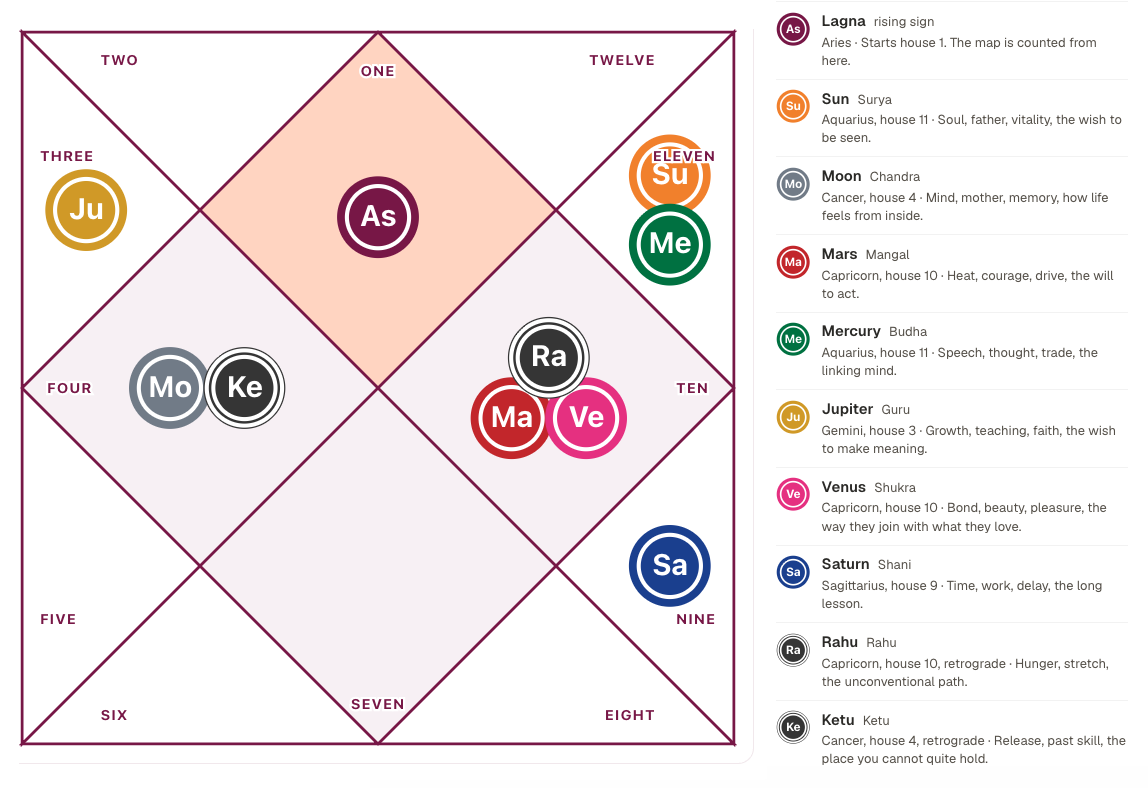
How Vedic Astrology Can Help
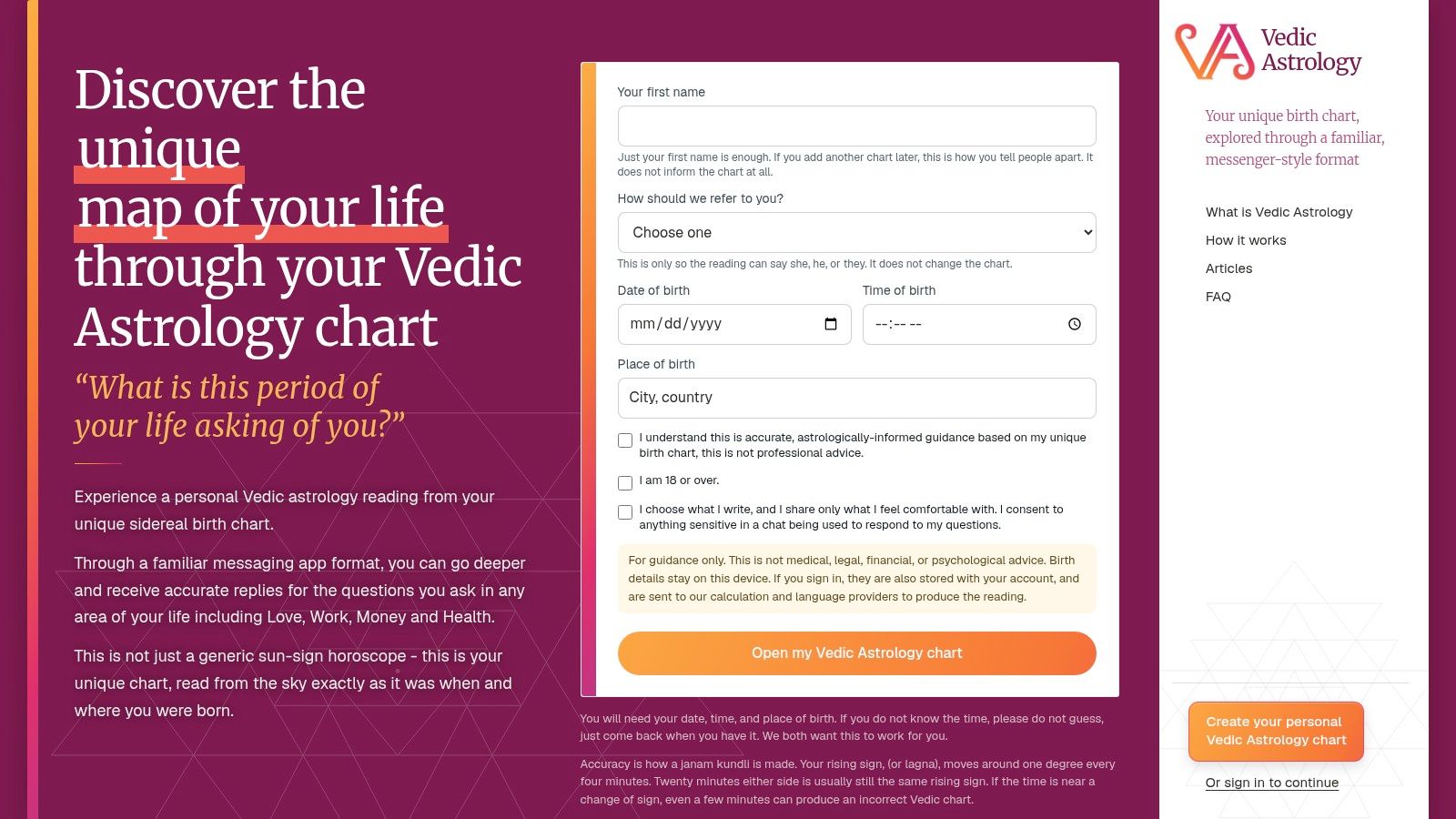
A reader who wants more than a changed Sun-sign label may prefer a tool built around a sidereal birth chart. VedicAstrology.com provides online Vedic astrology readings through a messenger-style interface, where users ask questions across specific areas of life and receive chart-based replies.
The service calculates a personal janam kundli from birth date, time and place, then works with Jyotish concepts including the lagna, Moon, nakshatras and dasha periods. Separate chats cover topics such as the next weeks, self, love, work, money, health, family, children, home, study, travel, spirituality and friends. That structure can help a reader avoid asking one generic horoscope to answer every kind of question.
When the format suits
The messenger approach may be useful if you want to explore questions incrementally rather than book a live appointment. Adding another person's chart, with permission, can support compatibility comparisons, while the articles library introduces janam kundli fundamentals, nakshatras and dasha timing.
It also addresses a common weakness of casual horoscope content, the lack of a reading anchored to an individual's complete chart. Exact birth time remains important, and the service warns users against guessing when accuracy matters. Its disclosures state that guidance is informational and isn't medical, legal, financial or psychological advice.
Privacy deserves attention before entering birth details. The site's data notes say details remain on the device by default, while signed-in data are stored with the account and shared with calculation and language providers to generate readings. Readers who want the technical background can learn more about sidereal (Vedic) astrology before deciding whether this style fits their needs.
Choosing a System for Horoscopes and Compatibility
Choose the framework according to the question, not according to which label sounds more authentic. If you're reading a mainstream Australian horoscope, use the tropical sign the column expects. Switching to a sidereal sign halfway through the same column will make the interpretation harder to follow.
Everyday horoscope reading
Most Western horoscope content is written in tropical terms. That includes the sign language used by many popular apps, newspaper columns and casual online discussions. If a friend asks whether you're an Aries or Taurus, they're usually asking within that familiar tropical frame.
That doesn't make the answer universal. If a Vedic practitioner asks for your Moon sign, they may mean the sidereal Moon sign, because Jyotish often gives the Moon and lagna more interpretive weight than a simple Sun-sign column.
Relationships and compatibility
Compatibility needs more care than comparing two Sun signs. A tropical reader may focus on psychological themes, communication patterns and the relationship between planets in a Western chart. A Jyotish practitioner may examine sidereal placements, lunar factors, nakshatras and traditional matching methods such as kundli or ashtakoot.
The practical question is whether both people were calculated using the same settings. Comparing one person's tropical chart with another person's sidereal chart doesn't create a meaningful like-for-like comparison. Ask for the zodiac and ayanamsa before treating a compatibility result as significant.
Career and timing
Predictive work is where many readers encounter a clear difference in method. Vedic astrology commonly uses dasha periods to organise life phases, while Western practitioners may use transits, progressions or other timing techniques. A person who uses tropical astrology for self-description may still choose a sidereal Jyotish reading for timing.
Some practitioners deliberately use both. That hybrid approach can work if the reader keeps a written record of which system answers which question. It becomes confusing only when a tropical placement is interpreted with sidereal rules, or when a sidereal placement is placed into a tropical horoscope without explanation.
Decision rule: Pick one system for each reading, record its settings, and don't combine conclusions until you know which framework produced them.
For Australian clients, cultural context can also guide the choice. Indian-Australian and Sri Lankan-Australian families may already be familiar with Vedic consultations for marriage matching or life-event timing. Other readers may feel more at home with the tropical language they've encountered in local media. Familiarity matters, but consistency matters more.
Checking and Converting Your Chart in Australia
The phrase “convert my chart” can be misleading. You aren't replacing Aries with Pisces in a list of signs. A sidereal chart recalculates planetary longitudes and may alter the Ascendant, house cusps and the way the whole chart is interpreted.
Start with the birth record. An exact time from a birth certificate or reliable hospital record is better than a family estimate. Australian readers should also check the relevant state records, such as the NSW Registry or Victorian Births, Deaths and Marriages, where available, and confirm the historical time-zone and daylight-saving setting for the birth date.
A reliable checking sequence
Enter the complete birth data. Use date, local time and birthplace rather than only the city name.
Select the zodiac explicitly. Choose tropical for a Western chart or sidereal for a Vedic-style chart.
Name the ayanamsa. If you select Lahiri, record that choice so another calculator can reproduce it.
Check the Ascendant and houses. These can change when the reference frame changes, especially near boundaries.
Compare degrees, not only signs. A planet at an early degree and a planet near the end of a sign won't respond to the offset in the same way.
Tools such as Astro, Seek and Jagannatha can help experienced readers compare settings, but menus vary and some services require careful configuration. A practitioner in Sydney, Melbourne or Perth can explain the choices directly, while an online practitioner may offer a convenient consultation and bill in Australian dollars. Verify the person's method before booking.
Astronomy and astrology also need separate labels. The International Astronomical Union's constellation framework concerns official regions of the sky, while tropical and sidereal astrology use their own zodiac conventions. Neither Western nor Vedic astrology becomes scientific because it uses astronomical coordinates. Readers exploring digital tools and birth-data services may also find this guide to building a dynamic digital lifestyle in Australia useful as a broader reminder to check how online platforms handle personal information.
Common Misconceptions Worth Putting Aside
The first misconception is that a zodiac sign is the same as a visible constellation. The International Astronomical Union defines official constellation boundaries, while astrology generally uses twelve equal signs. Those are different mapping systems. Tropical signs divide the zodiac by seasonal points, and sidereal signs use a stellar reference corrected through an ayanamsa.
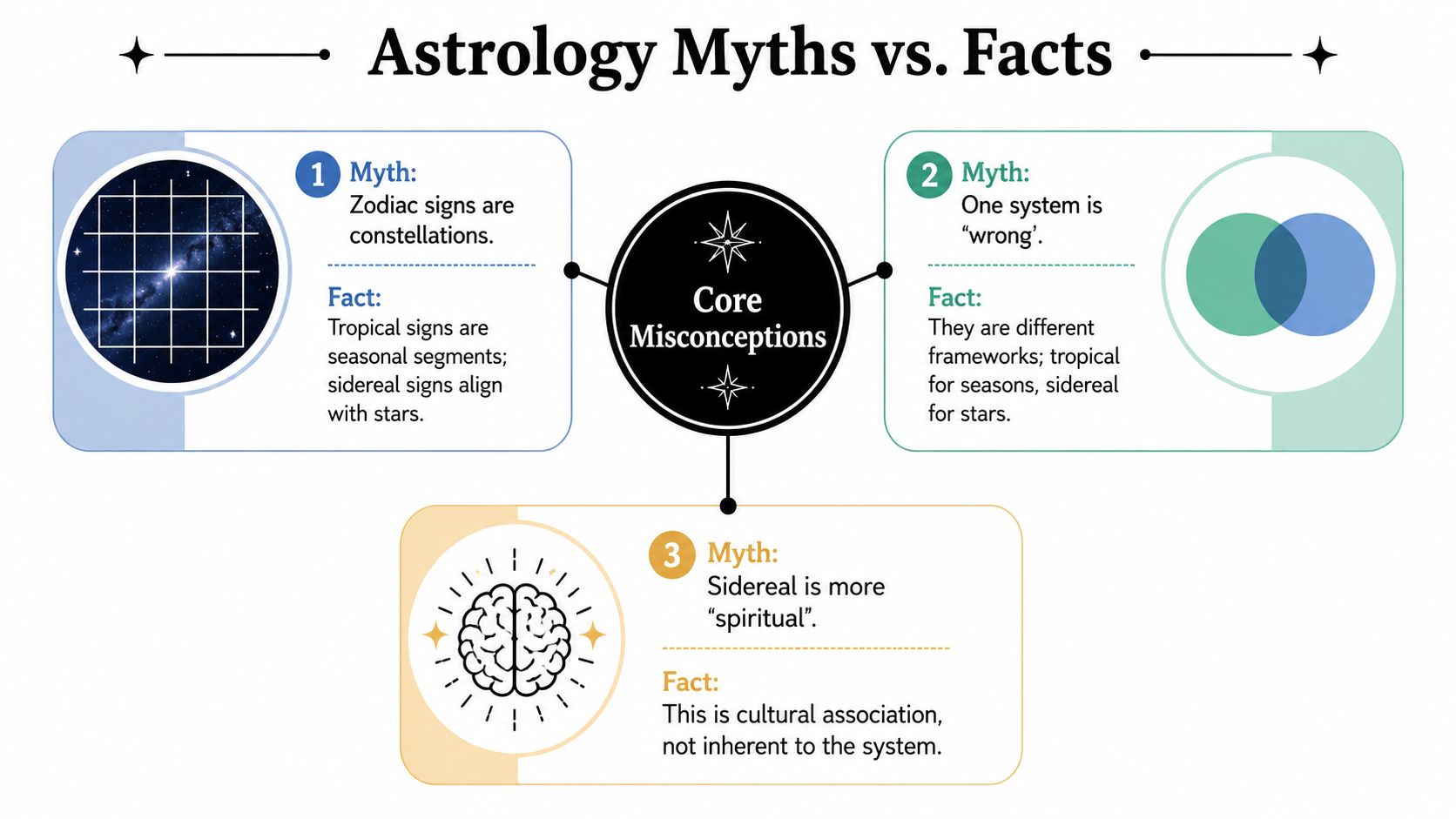
The second misconception is that Western astrology is automatically more scientific, or that sidereal astrology is automatically more spiritual. Both use symbolic interpretive frameworks. Tropical astrology is organised around the equinox and seasonal cycle, while sidereal astrology is organised around fixed-star reference points. Cultural associations may shape how people practise them, but they don't turn either framework into an objective scientific measurement.
The third misconception treats Vedic astrology as a sealed-off tradition with no historical exchange. The history of astrology includes movement between regions and intellectual traditions, so simple labels can hide a complicated development. At the same time, readers shouldn't use a broad historical connection to erase the distinct methods Jyotish developed in India.
What precession did not do
Precession didn't make tropical astrology “wrong” by moving the signs away from constellations. Tropical astrology was designed as an equinox-based zodiac. Its symbolic Aries begins at the equinox because that is the chosen reference, not because modern astronomers are expected to find the Sun inside the constellation Aries on that date.
The question “What's my true sign?” therefore assumes that one coordinate system must defeat the other. A better question is, “Which system is this reading using, and what does it intend to describe?”
For a quick wellbeing reset alongside any reflective practice, readers may also find these daily habits for improved mental health useful. Astrology can support reflection, but it shouldn't replace qualified care or practical decision-making.
Practical Recommendations and FAQs for Aussie Readers
Start with the purpose of the reading. A tropical chart is usually the least confusing choice for a daily horoscope because Australian mainstream horoscope content is commonly written in tropical sign language. A sidereal chart is the clearer choice when you specifically want a Jyotish consultation involving lagna, nakshatras, Moon-centred interpretation or dasha timing.
A simple choice guide
Daily horoscope: Stay tropical if you're following a Western newspaper column or app.
Self-understanding: Try the system whose language and practitioner you can follow consistently. Comparing both can be useful, but keep separate notes.
Compatibility: Use the same zodiac and calculation settings for both people, then ask what method the practitioner applies.
Predictive timing: Choose a practitioner who can explain the timing technique, particularly if the reading uses sidereal Jyotish and dashas.
A changed Sun sign: Check the exact degree before assuming your entire identity has shifted. Your Moon, Ascendant and other planets may tell a more complex story.
Australian readers should treat birth information as personal data. Use services with clear privacy explanations, avoid sharing details publicly, and check whether an account stores information remotely. A birth chart can be reflective and entertaining, but medical, legal, financial and psychological decisions belong with appropriately qualified professionals.
Frequently asked questions
Why isn't Ophiuchus used in most zodiac readings?
Most tropical and Vedic systems use twelve equal signs, not the unequal astronomical constellation boundaries. Ophiuchus is an official constellation in astronomy, but its existence doesn't automatically add a thirteenth sign to every astrological system. A calculator that includes it is using a different model and should say so clearly.
Does the precession gap keep growing?
Yes, the separation continues to change gradually as Earth's axis precesses. The important practical point is that the current difference is already large enough to move many placements into the preceding sidereal sign, especially near boundaries. Future calculations should still name the ayanamsa and date rather than treating the offset as permanently identical.
How can I verify my sidereal Moon sign?
Enter your exact birth date, local birth time and birthplace into a calculator that clearly offers a sidereal setting, then select the ayanamsa used by your practitioner. If the Moon is near a sign boundary, compare the degree across more than one reputable tool or ask a Jyotish practitioner to confirm it. Don't rely on a date-only sign table because the Moon's position depends strongly on time.
Will same-sign couples get better timing guidance from Vedic dashas?
Being the same tropical or sidereal Sun sign doesn't determine whether a timing method will be useful. Vedic dasha interpretation uses the complete chart and the relevant planetary periods, so both partners need accurate birth details and separately calculated charts. A practitioner should explain what is being timed rather than promising that a shared sign guarantees compatibility or relationship outcomes.
Should I use tropical for personality and sidereal for timing?
You can, provided you label the systems and don't blend them unconsciously. Some practitioners use tropical techniques for psychological interpretation and sidereal Jyotish for predictive work, while others stay within one tradition. The best choice is the method you understand, can reproduce and can discuss with a practitioner who is transparent about their calculations.
Can I use both systems without confusing myself?
Yes. Keep two clearly named chart files, such as “tropical” and “sidereal Lahiri”, and write the purpose beside each interpretation. Compare placements only after checking the zodiac, ayanamsa, house system and birth data. If the process starts creating anxiety or replacing practical judgement, pause and return to grounded support. Readers interested in reflective routines can explore this beginner's guide to meditation techniques for stress reduction.
The most useful conclusion is modest. Tropical astrology offers the familiar seasonal framework used by much of Australian popular horoscope culture. Sidereal astrology offers a stellar reference and a Jyotish tradition with its own methods for chart interpretation and timing. Neither label needs to cancel the other, but every reading should state which system it uses.
If you're curious about your own result, retrieve your most accurate Australian birth time, calculate the chart in tropical and sidereal Lahiri settings, and compare the Sun, Moon and Ascendant side by side. Then bring those clearly labelled charts to a qualified practitioner, and share what you learn with The Kotaku Times community through its Australian lifestyle coverage.