
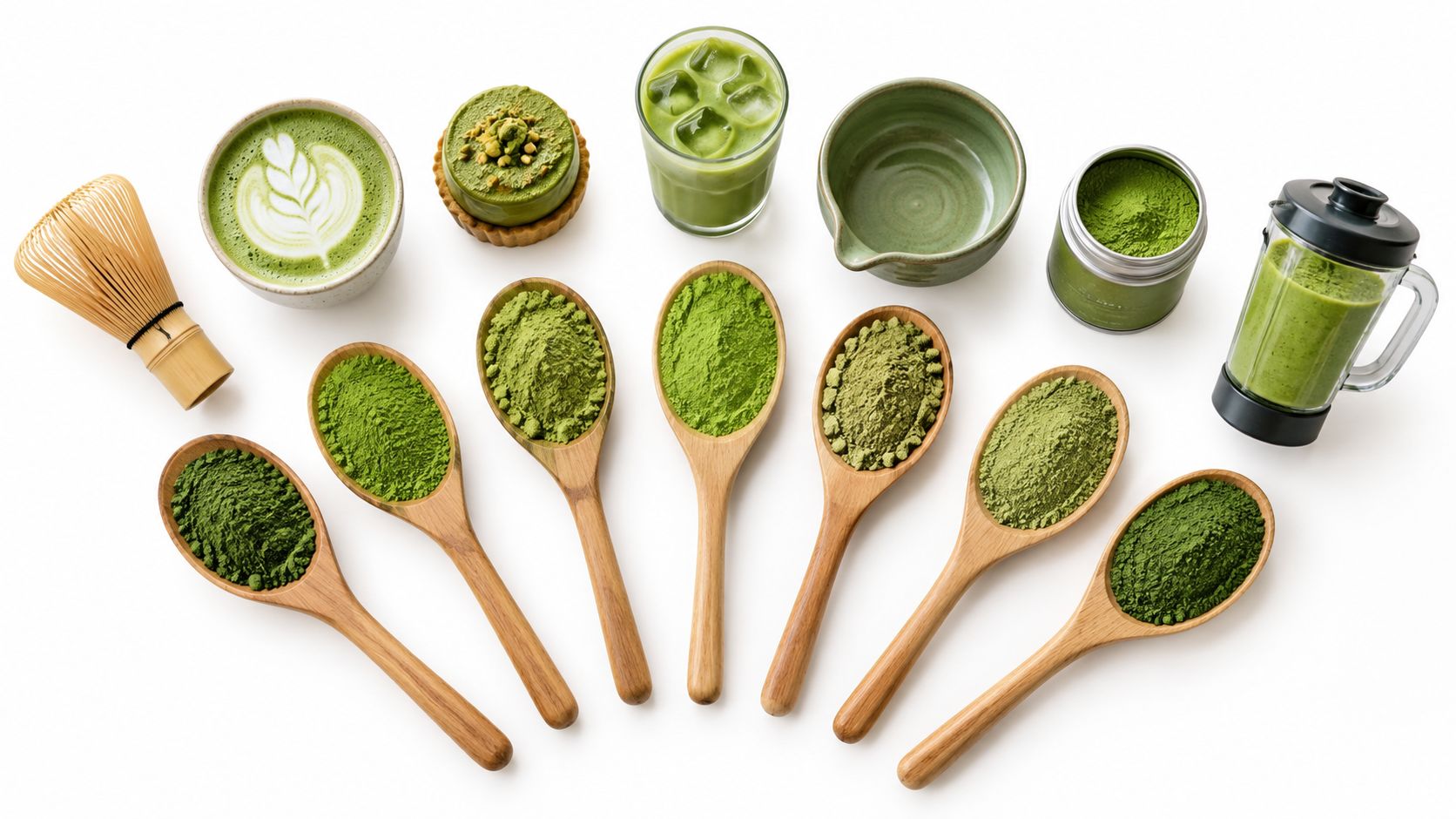
You're standing in the tea aisle, or scrolling through a product page, and every matcha tin seems to promise the same thing: bright green colour, smooth texture and calm energy. Then the labels split into ceremonial, premium, latte and culinary, while the origin, harvest and testing details sit in small print. The result is easy to predict. You buy an expensive tin for lattes, or a mild cooking powder and expect it to shine in water.
The best matcha depends on the cup you're making. This guide matches Australian-available retailers to specific jobs, from traditional whisking to milk drinks and baking. It also looks at Japanese origin, flavour profile, freshness, caffeine transparency, grade, certifications and practical buying conditions for Australia and New Zealand. Start with the use case, then choose the grade. That approach saves more money than chasing the most impressive label.
Table of Contents
- 1. Tealyra for the widest choice
- 2. Kenko Tea for local range and value
- 3. Purematcha Australia for lab-conscious buyers
- 4. Zen Wonders for Uji and Kyoto character
- 5. iki Matcha for single-farm traceability
- 6. Matcha Yu Tea for beginners
- 7. Maison Koko for enthusiasts
- 8. Ippodo Tea for Kyoto benchmarks
- Top 8 Matcha Brands Comparison
- Match the Grade to the Drink and Keep It Fresh
1. Tealyra for the widest choice
Tealyra's matcha collection suits buyers who want to compare rather than commit to one house style. The store carries a broad selection of matcha alongside loose-leaf tea, tea bags and accessories, so it's useful if you're building a complete setup instead of replacing one tin.
That range solves a common problem. A beginner may want one powder for water, another for oat-milk lattes and a third for baking, but many specialist brands focus on a narrower catalogue. Tealyra makes the comparison easier because you can shop by intended use and explore different origins, grades and formats in one place. The trade-off is decision fatigue. A large collection only helps if you read the product details instead of choosing by colour alone.
Choose by the drink, not the label
For straight matcha, look for a product with a clean ingredient list, named Japanese origin and tasting notes that mention sweetness, umami, grassiness or bitterness. A more full-bodied culinary powder can work in a latte because milk softens sharp edges and adds body. The same powder may taste flat or rough when whisked with water.
For baking, colour and cost matter more than delicate aroma. Chocolate, citrus, vanilla and sugar will dominate the finished recipe, so a premium drinking matcha can be wasted in biscuits or cakes. Tealyra is strongest when you want to make that distinction across several products.
Practical rule: Buy the smallest sensible pack when you're testing a new grade. Freshness matters more than owning a large tin you rarely open.
What to verify before checkout
Check the country of origin, harvest information, ingredients, best-before date and storage instructions. If a product makes organic or quality claims, look for the relevant certification rather than treating “ceremonial” as proof. That term isn't a universal legal grade, and retailers use it inconsistently.
Australian supply is heavily dependent on imports. Commercial market analysis indicates that Japanese and Chinese imports account for more than 90% of domestic matcha demand, with Japan representing an estimated 65–75% of import value. These are directional commercial estimates, not audited government consumption totals, but they explain why provenance and supply-chain detail matter when comparing products in Australia. The Australian market analysis provides that context.
2. Kenko Tea for local range and value
Kenko Tea is a practical choice for Australian buyers who want a specialist retailer with a clear ladder from everyday drinking powder to premium ceremonial matcha. The Melbourne-based business imports matcha from Japan on a regular schedule and offers ceremonial, latte and culinary grades, along with single-cultivar options and larger café packs.
The range works well for households that use matcha in different ways. Choose a more expressive ceremonial product for whisking with water, then move to a latte or culinary grade when milk, fruit, sugar or baking ingredients will share the cup. Bulk formats also make sense for cafés and regular home users, but only after you've tested the flavour in your actual recipe.
Freshness and selection
Kenko Tea lists sourcing from Uji, Shizuoka and Kagoshima, and its monthly air-freighted supply is designed to support fresher stock. That's useful because matcha's aroma and colour decline after opening, especially when the powder sits warm or exposed to air. A retailer can't replace good storage, but regular replenishment gives you a better starting point.
The downside is choice overload. Beginners may find several plausible ceremonial options without knowing whether they prefer sweet and creamy, savoury and umami-rich, or more grassy and assertive. Use the retailer's preparation and buying guides, and start with a small tin rather than jumping directly to a café pack.
Kenko also sells accessories and wholesale quantities up to 1 kg, according to its product range. Don't treat that format as a bargain until you've compared two grades side by side and confirmed that your customers or household prefer the blend.
For broader lifestyle context, readers may also appreciate this guide to natural detox remedies, but matcha itself shouldn't be sold as a detox treatment. Buy Kenko Tea when local availability, transparent grade descriptions and a broad value range matter more than a highly curated single-farm story.
3. Purematcha Australia for lab-conscious buyers
Purematcha Australia is aimed at shoppers who want more product information than a green tin and a ceremonial badge. The Sydney-based importer focuses heavily on Japanese matcha, organic lines and small-batch releases, with product pages that identify details such as cultivar, region and harvest.
That specificity helps when you're trying to understand why two powders cost different amounts. A named cultivar and region won't guarantee that you'll prefer the flavour, but they give you a useful way to compare one lot with the next. The range also spans small tins through café and ceremonial formats, so you can scale up after tasting rather than guessing.
Testing is more useful than marketing
Purematcha highlights independent batch testing and JAS-certified organic products. Those details are more valuable than generic claims about purity, but read them carefully. A certification applies to a defined product and process. It doesn't automatically tell you the caffeine content of your prepared drink, and it isn't a substitute for checking the lot information.
A practical certificate of analysis should identify the tested batch and cover relevant hazards such as heavy metals, pesticides and microbial safety. One Australian retailer has reported sending matcha samples to Agrifood Technology in Werribee, a NATA-accredited laboratory, every six months. Its March 2026 samples reportedly showed lead results of 0.067 mg/kg and 0.071 mg/kg, described as below applicable Australia and New Zealand Food Standards Code limits. Those were product-specific results, not a market-wide benchmark, as explained in the FSANZ caffeine report.
Purematcha's compare-grades tool and starter sets are useful for newcomers, although premium organic lots can cost more than conventional options and popular single-cultivar products may disappear temporarily. This is the retailer to choose when batch detail and certification carry as much weight as taste. For related nutrition context, see the plant-based diet myths and facts guide, but keep matcha claims specific and evidence-based.
4. Zen Wonders for Uji and Kyoto character
Zen Wonders takes a curated approach. Instead of presenting the broadest possible catalogue, it concentrates on artisan Uji and Kyoto lines, including ceremonial and latte grades such as HANAE and YUKIRO. That focus makes it a good fit for someone who already knows they want a Kyoto expression rather than a general-purpose imported powder.
Uji-style matcha often appeals to drinkers who want a rounded, fragrant cup with sweetness and umami. It can also work in milk, but don't assume every premium ceremonial product is ideal for a latte. A delicate powder may lose its detail under oat milk, syrup or ice. Zen Wonders' grade charts help separate products intended for water from those with enough flavour to hold up in a café-style drink.
Curated lots come with trade-offs
Regular air-freight to Australia supports the freshness proposition, and free Australian shipping over A$100 can make a larger order more practical. Still, limited heritage and pinnacle lots carry a higher price, and rotating stock means the product you enjoy may not remain available. That's part of the appeal for enthusiasts, but it's inconvenient if you need a consistent café recipe.
Buy Zen Wonders for a focused Uji and Kyoto selection, local delivery and a stronger emphasis on curated ceremonial choices. It's less suitable if you want one permanent house powder for every application or need a large, predictable wholesale catalogue.
Before buying, ask whether the product page states the origin, grade, harvest and lot details. Also check whether the retailer provides a recent certificate of analysis. “Ceremonial” describes intended drinking quality in common retail language, but it doesn't replace evidence about contaminants, ingredients or caffeine disclosure.
5. iki Matcha for single-farm traceability
iki Matcha keeps its proposition narrow. The Melbourne-based brand sources first-harvest ceremonial matcha from one JAS-certified farm in Kagoshima, then publishes independent lab results by batch. That makes it a strong option for drinkers who value consistency and traceability over regional variety.
A single-farm profile can simplify the buying decision. You're not comparing a rotating blend of cultivars and regions every time you reorder. If you like the flavour, the next purchase should aim for the same general character, subject to seasonal and batch variation. The focus also makes iki easier to evaluate in a side-by-side tasting.
The cost of a narrow catalogue
The likely appeal is a smooth, relatively low-bitterness cup that works well when whisked with water. It can also suit iced drinks and lighter lattes, but a highly flavoured milk drink may reduce the benefit of paying for a delicate ceremonial product. For strong syrups, smoothies or baking, a latte or culinary grade may be more rational.
iki offers same-day dispatch from Melbourne, free Australian shipping over A$69 and a 30-day money-back guarantee, according to its stated retail terms. Those policies reduce the risk for a first order, but they don't turn every ceremonial matcha into the right matcha for your routine. Read the preparation guidance and test the powder without sweetener before deciding whether the flavour justifies a repeat purchase.
Traceability matters most when you'll reorder: Keep the batch details from a tin you love, then use them when asking about the next release.
The limitation is clear. This isn't the retailer for someone who wants to move between Uji, Nishio, Shizuoka and Kagoshima profiles. It's the better pick for a stable single-origin starting point and published testing. If sleep is a concern, matcha should be part of your overall caffeine routine, not treated as a harmless evening drink. The science of sleep guide offers broader practical context.
6. Matcha Yu Tea for beginners
Matcha Yu Tea removes much of the terminology that makes first-time buying difficult. Its range separates an Everyday product for lattes from a Premium product for whisking, and the brand explains its direct Japanese sourcing and cold storage in Australia. That simple split is useful if you don't want to compare a long list of cultivars before making your first drink.
The freshness approach is sensible. Air-freighting matcha and refrigerating it locally can slow oxidation, but the buyer still needs to reseal the package quickly and avoid repeated exposure to warm, humid air. A cold-storage claim is helpful. It isn't permission to leave an opened pouch beside the kettle.
A clear grade split
Use the Everyday option when milk, ice, sweetener or fruit will be part of the recipe. It should provide enough flavour and colour without asking you to pay for nuances that the other ingredients may cover. Choose Premium when the drink is mostly matcha and water, where bitterness, sweetness, aroma and texture are easier to judge.
Matcha Yu Tea highlights awards and recognitions on its product pages and offers a 30-day taste guarantee for first-time customers, according to its retail information. The catalogue is smaller than a multi-brand retailer, which can be a benefit for beginners but a limitation for enthusiasts who want detailed regional comparisons.
The brand's scepticism about “ceremonial grade” is also useful, even if it may confuse shoppers who expect that label to define a universal standard. Treat the term as a retail descriptor. Give more weight to origin, freshness, ingredients, harvest, testing and the drink you plan to make.
FSANZ states that naturally occurring caffeine in tea doesn't have a general maximum concentration under the Food Standards Code, while foods containing 5% or more caffeine in solid or semi-solid form, including powders, and 1% or more in liquid form are prohibited from retail sale in Australia and New Zealand. Added caffeine must be declared. FSANZ's caffeine guidance explains the regulatory baseline. Matcha Yu Tea is a good starting point if you want straightforward grade guidance, but ask for serving information if you need predictable caffeine intake.
7. Maison Koko for enthusiasts
Maison Koko suits the buyer who wants to explore matcha beyond a single everyday blend. Its Australian-available range includes Japanese single-cultivar and blended products associated with regions such as Uji and Yame, with several ceremonial tiers and limited first-harvest releases.
The useful feature is the flavour information. Region and cultivar notes give experienced drinkers a vocabulary for comparing a soft, sweet blend with a more savoury or assertive single-cultivar powder. Blends tuned for usucha can also work in lattes when they have enough body, but a finely nuanced release may be better enjoyed with water.
Explore without overbuying
Maison Koko lists competitive options among its smaller ceremonial tins, which makes tasting across tiers more realistic than committing immediately to a large pack. Availability is the main frustration. Premium releases can move in and out of stock, and marketing-heavy product pages may require beginners to translate elegant tasting language into a practical choice.
Start with a blend if you're still learning your preference. It's generally easier to find a balanced profile that works across hot, iced and milk-based drinks. Move to a single cultivar when you want to isolate a particular style and are willing to accept more variation between releases.
Check whether the product page includes country of origin, cultivar, harvest, lot and best-before information. The right product should also explain storage after opening. A striking green colour is useful as an initial clue, not proof of freshness or safety.
Maison Koko is the best fit here for someone who treats matcha like coffee or wine and wants to compare profiles. It's not the simplest first purchase if you only need a dependable latte powder. For a café, order samples first, record the recipe and taste each option in the milk you serve. A powder that tastes excellent with water may disappear in a large, sweetened latte.
8. Ippodo Tea for Kyoto benchmarks
Ippodo Tea is the import choice for purists who want to buy from a long-established Kyoto tea house rather than an Australian specialist retailer. Its Global shop offers a deep ceremonial catalogue, from accessible drinking styles through richer thick-tea options and seasonal releases, and ships to Australia.
The appeal is consistency across a broad flavour spectrum. An experienced drinker can choose a more delicate matcha for usucha, then move to a deeper, fuller style for thick tea. That range also gives you a useful benchmark when judging newer brands. If you're still learning, however, the catalogue can feel more like a study course than a quick shopping trip.
Import costs change the calculation
International shipping methods, delivery windows, currency conversion and possible duties all affect the final landed cost. DHL is often used, but shipping arrangements can change. A product that looks competitive before checkout may be less attractive once freight and currency costs are added.
Ippodo's premium ceremonial matcha is best treated as a water-first purchase. Milk can be enjoyable, but it hides the aroma and texture you're paying to experience. For a daily latte, an Australian retailer with a suitable latte grade will usually be easier to reorder and simpler to cost.
Order from Ippodo when you value Kyoto provenance, seasonal depth and a recognised reference point. Buy locally when you prioritise delivery speed, lower logistical complexity or a product with Australia-specific serving guidance. Either way, inspect the packaging date and storage instructions, then buy an amount you can finish while the powder still smells fresh.
Top 8 Matcha Brands Comparison
| Item | 🔄 Implementation complexity | ⚡ Resource requirements | ⭐ Expected outcomes / quality | 📊 Ideal use cases | 💡 Key advantages / tips |
|---|---|---|---|---|---|
| Tealyra | Low–Moderate: standard e‑commerce curation and SKU management | Broad inventory of loose tea, tea bags and accessories; regular stocking | Reliable variety for different preferences; good entry-to-mid quality ⭐ | General shoppers who want widest selection and accessories | Wide selection across styles; natural fit for explorers, Tealyra's matcha collection |
| Kenko Tea | Medium: monthly air‑freight imports and large SKU range can require active inventory management | Monthly air‑freight from Japan; wholesale and café packs; accessory lines ⚡ | Fresh seasonal lots and clear grade breakdowns; value ladder across grades ⭐⭐⭐ | Shoppers wanting transparent grading, steady local availability, and café-scale supply | Clear grade info and strong local reviews; large range may overwhelm beginners |
| Purematcha Australia | Medium: small‑batch import logistics plus lab testing workflows | JAS‑organic focus, independent lab testing, same‑day dispatch from Sydney | High traceability and verified quality; good organic options ⭐⭐⭐ | Buyers prioritising organic certification, batch lab results, and cultivar/region details | Batch lab results and compare-grades tool; organic lots can be pricier |
| Zen Wonders | Medium: curated sourcing (Uji/Kyoto) with frequent air‑freight to maintain freshness | Regular air‑freight from Kyoto/Uji; curated ceremonial stock and accessories | Strong Uji/Kyoto expressions and curated ceremonial quality ⭐⭐⭐ | Enthusiasts seeking Kyoto/Uji profiles and curated ceremonial options | Practitioner endorsements and good latte grades; pinnacle lots are limited |
| iki Matcha | Low–Medium: simplified by single‑origin, first‑harvest focus | Single‑farm supply with per‑batch lab results and fast domestic dispatch ⚡ | Consistent single‑farm flavour profile with low bitterness; reliable quality ⭐⭐⭐ | Traceability-focused buyers who want consistent first‑harvest ceremonial matcha | Published lab results and 30‑day guarantee; limited regional variety |
| Matcha Yu Tea | Low: simple grade guidance and small, award‑recognised range | Direct sourcing + cold‑storage in Australia to preserve freshness; limited SKUs | Freshness‑forward offerings and clear latte vs whisking split ⭐⭐ | Beginners and customers wanting simple guidance on grades and freshness practices | Beginner-friendly guidance and 30‑day taste guarantee; smaller catalogue |
| Maison Koko | Medium: curated single‑cultivar and blended releases with rotating drops | Multiple ceremonial tiers, single‑cultivar drops and local AU availability | Good tasting detail for enthusiasts; competitive pricing on some ceremonial SKUs ⭐⭐⭐ | Enthusiasts seeking diverse ceremonial tiers and single‑cultivar releases | Clear tasting notes and region/cultivar info; some premium tins rotate out of stock |
| Ippodo Tea (Global shop) | High: international ordering, historic producer logistics and seasonal releases | Long‑established Kyoto producer; international shipping, duties and variable delivery | Benchmark ceremonial quality and consistency; wide flavour spectrum ⭐⭐⭐⭐ | Purists and experienced drinkers willing to import from a historic Kyoto tea house | Historic, benchmark quality; shipping fees and landed cost vary by order |
Match the Grade to the Drink and Keep It Fresh
The practical rule is simple. Choose the grade by the drink, not by the prestige of the label. Ceremonial-style matcha makes the most sense when water is the main ingredient and you want to notice aroma, sweetness, umami and texture. A latte grade is more efficient when milk, ice or sweetener takes centre stage. Culinary matcha belongs in recipes where colour and a clear tea note need to survive sugar, flour, dairy or fruit.
The list gives you a sensible starting point for each job. Choose Tealyra when you want to compare a wide range. Choose Kenko Tea for a local value ladder and café formats. Purematcha Australia suits lab-conscious buyers. Zen Wonders focuses on Uji and Kyoto expressions. iki Matcha keeps the flavour profile and farm story narrow. Matcha Yu Tea makes the first purchase easier. Maison Koko gives enthusiasts more cultivar and region detail. Ippodo is the benchmark import for experienced drinkers.
Don't jump straight to the largest pack. Test two grades side by side using the same water, powder quantity and whisking method. Then repeat the comparison in your usual latte recipe if that's how you drink matcha. A powder that wins in water may not win with your preferred milk, and a bright culinary option may outperform an expensive ceremonial tin in baking.
Caffeine deserves the same practical treatment as taste. FSANZ says caffeine levels in naturally caffeinated foods such as tea and coffee will not normally exceed 100 milligrams in a standard serving, although the actual amount varies with powder quantity, cultivar, preparation method and serving size. Its caffeine information also notes evidence of increased anxiety in children at approximately 3 mg per kilogram of body weight per day. Children, pregnant people, anyone with anxiety or sleep problems, and people taking medicines that may interact with caffeine should seek individual advice rather than rely on wellness marketing. A responsible seller should explain the powder amount and provide caffeine guidance where possible.
Store unopened matcha according to the retailer's instructions. Once opened, keep it sealed, cool and away from light, heat, moisture and air. A refrigerator can help, but protect the package from condensation and let it reach room temperature before opening if cold storage causes moisture to form. Use a clean, dry scoop, close the tin immediately and avoid keeping it beside a steaming kettle.
Choose one starting tin from the list, brew it in the drink you normally make, and record what you like. If you're buying for a café or regular household use, contact the retailer for a recent certificate of analysis, lot information, origin, caffeine guidance and a sample before ordering bulk stock. That small step is the best way to find your best matcha without wasting money on the wrong grade.